Prove you can think on your feet.
This measures the one skill that stays unmistakably human: making a complex case out loud, in real time, under interruption. You get a Communication Score, a worldwide percentile, and a five-dimension profile. Free, verifiable in one click.
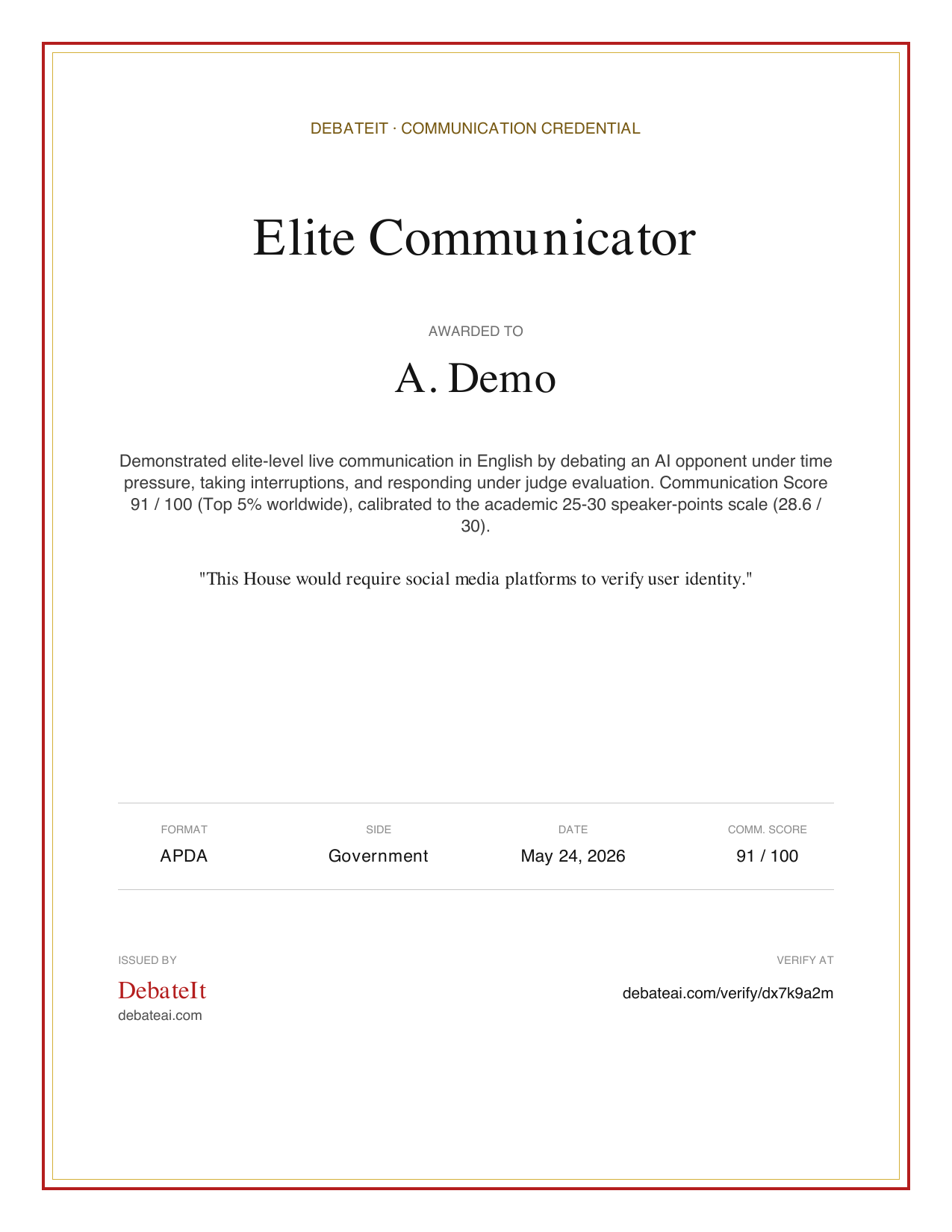
This is what gets issued.
Every assessment generates a clean one-page PDF you can attach to an application or print. It carries a verify URL, so a forged copy that does not match the live page is caught in two clicks.
The value of written credentials is falling. The value of live communication is rising.
Anything you can prepare in advance, a model can now help you produce. What it cannot do is sit in the chair for you when someone pushes back in real time. That line is what the whole credential is built on.
- ○ Essays
- ○ Resumes
- ○ Cover letters
- ○ Take-home assignments
Polished in advance, on your own time, with help. The reader can no longer tell how much of it was you.
- ✓ Interviews
- ✓ Negotiations
- ✓ Presentations
- ✓ Debates
- ✓ Sales conversations
Live, unscripted, under pressure. No second draft, no outside help, no way to fake it. This is what the credential measures.
Five dimensions of live communication.
Every assessment produces a five-axis profile, not a single grade. The composite produces the tier; the five sub-scores produce the communication profile, which is where the coaching value lives.
The composite is a weighted blend of the five sub-scores, mapped onto the academic 25-30 speaker-points scale. The composite produces the tier. The five sub-scores produce the communication profile, visible on your personal dashboard alongside a sparkline of how each axis is trending across rounds.
Three steps. About ten minutes.
Pick a motion, pick a side
APDA, BP, WSDC, Policy, LD, PF, Congress, MUN, or impromptu Quick Clash. The format you pick determines the round shape and the register the AI uses.
Argue out loud
Live voice, real time pressure. The AI takes points of information, interrupts, and pushes back. You speak for the time the format demands.
Get your score
An AI judge writes a ballot and turns it into your Communication Score and percentile. Clear the median and you earn a shareable credential at a public verify URL. Below it, you still keep your score and profile to train from.
Eight beats. Five to eight minutes of you talking.
A structured live exam, not an open-ended chat. Fixed timing, fixed weighting, identical for everyone. This is the flow the certificate is calibrated against.
The casual voice round (any motion, any length, no fixed structure) stays available as the practice surface. The structured eight-step assessment above is what produces a credential you can hand a school or an employer.
One ladder, from your first round to the top 1%.
Everyone who finishes a live assessment gets a Communication Score and a worldwide percentile. Clear the median and you earn a shareable, verifiable credential at one of four levels above. The levels are calibrated to the 25-30 speaker-points scale university tournaments use, so the badge carries weight in rooms that already know that scale and reads instantly for everyone else.
Levels are calibrated to the academic 25-30 speaker-points scale that university tournaments grade on: the median varsity speaker (27.0) sits at the Effective bar, and a final-round speech (29.0+) maps to Exceptional. The score you see is that judged result, rescaled to the 0-100 Communication Score. Percentile bands are descriptive guidance, not a psychometric mapping, and not a substitute for IELTS / TOEFL / Cambridge where a program specifically requires those tests.
Different rooms, one communication profile.
The live debate round is the assessment available today. More pathways are on the way, each a different kind of live pressure: a hiring interview, a stakeholder conflict, a sales objection. Every pathway you complete writes to the same Communication Score and profile, so the credential reflects how you hold up across the situations that actually matter.
Built for the audience traditional tests lock out.
A student in Lagos, Delhi, São Paulo, Nairobi, or Jakarta should be able to prove "I can communicate complex ideas in English under pressure," without a $215 test-center sitting, a flight to a regional capital, or an elite-school transcript opening the door. That access is the reason this credential exists.
For Indian students applying out of CBSE / ICSE / IB schools
A spoken-English signal that complements IELTS / TOEFL submissions and stands on its own in Indian-circuit university applications. Format-aware: Asian Parli, WSDC, and Frank Anthony register are scored on their own merits, not flattened to American norms.
For African applicants targeting global universities or remote roles
A free credential that proves live English competency without sitting an IELTS in Lagos at a price most applicants can't justify. The verify URL is anywhere with a browser; the credential is anywhere with a verify URL.
For SE Asian remote workers in global hiring pools
If your work involves arguing live in English (customer-facing roles, consulting, sales, support), your resume currently has no way to prove that. The communication profile does.
For Latin American applicants to English-medium programs
Pairs with TOEFL / Duolingo English Test as a parallel signal. The eight-step structured assessment is sittable from any laptop with a microphone. No Pearson Vue appointment required.
For applicants from contexts where elite institutional access is limited
A portable credential that travels with you across borders, visa systems, and admissions cycles. The credential is not tied to a school you attended or a country you took a test in. It's tied to a five-minute live round you can defend.
For founders, consultants, lawyers, and policy students
If oral argumentation is the actual job (pitching investors, defending a client, briefing a stakeholder), the credential proves you can do that under live pressure. Distinct from any written credential on your resume.
DebateIt runs in 14 spoken languages (Hindi, Spanish, French, Portuguese, Arabic, Mandarin and more), though the certificate program is currently English-first. Localized assessments, native-language sub-tracks, and cross-language voice-converted debates are on the roadmap so two speakers from different backgrounds can still clash in one room.
How it compares to English-speaking exams.
DebateIt Certificates measure adversarial spoken English under live time pressure, the one signal that AI cannot trivially generate. That's a different skill than the structured monologue and interview formats above. We don't compete with IELTS / TOEFL / Cambridge for contexts that specifically require those exams; we offer a parallel signal that's free, faster, real-time, and tests something they don't.
The certificate is the trophy. The profile is the product.
A page you come back to, not a PDF you file away.
Every assessment writes to one public profile: your Communication Score, your percentile, and a five-dimension radar that shows exactly where you are sharp and where to drill. Think Chess.com rating page, not a certificate in a drawer.
Round history sits below the radar: every assessment with date, format, motion, score, and its own verify URL. The score is a number you can train, and the profile is where you watch it move.
Open your profile →Sample profile · Elite Communicator · Top 5% · Strengths: reasoning, persuasion · Drill: responsiveness under interruption
A recruiter understands the candidate in thirty seconds.
Every credential lives at a public, no-contact verify URL: debateai.com/verify/{id}. Open it and the whole picture is on one screen. No login, no API key, no email-the-issuer-and-wait.
What each side gets
Employers see a Communication Score, a percentile, the five strengths and weak spots, and a transcript sample of the candidate actually arguing under pressure. The signal a resume cannot carry.
Universities and admissions get a complement to SAT, IELTS, TOEFL, and the Duolingo English Test: live reasoning, listening, and pressure-handling, scored on a scale built from academic debate.
If your program would like to formally recognize DebateIt credentials for co-curricular credit, English-proficiency portfolios, or admissions weighting, we would like to talk. Bulk verification, custom rubrics, and faculty-issued ballots are on the roadmap.
For educators and recruiters →Where the credential is going.
The score and the profile are live today. These are the next layers that turn a one-time certificate into something you keep coming back to. Each ships honestly: when a layer is live it shows on the verify page, and until then it is marked as coming.
Honest answers.
Get your score.
Five to eight minutes against a live AI. Free, sign in only after you have cleared the bar so the credential is tied to you. Your Communication Score, percentile, and verify URL are public the moment they are minted.
Get your score → See a sample profile